

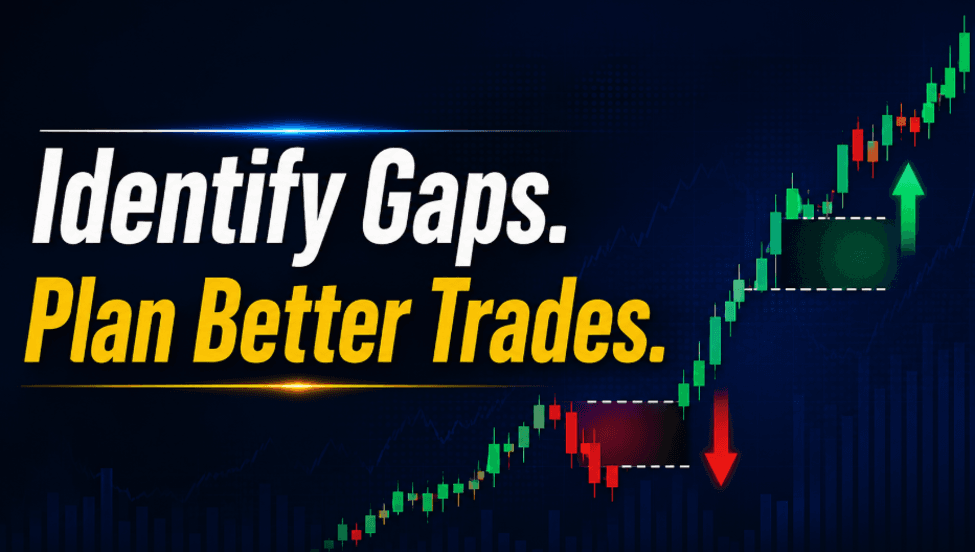
Gap Up and Gap Down Trading Strategy: A Complete Guide
Gap Up and Gap Down are common price movements that traders often see at the market opening. A Gap Up happens when a stock or index opens at a higher price than the previous day's closing price, while a Gap Down happens when it opens at a lower price. These price gaps are usually caused by important news, company results, economic events, or changes in market sentiment. For option traders, gap movements can create trading opportunities if they are analyzed correctly.
However, successful gap trading is not just about identifying a Gap Up or Gap Down. Traders also need to know when to enter a trade, where to place a stop-loss, how to set a target, and how to manage risk. Following a proper trading strategy can help traders make more informed decisions and avoid common mistakes.
In this complete guide, we will explain the Gap Up and Gap Down trading strategy and learn how option traders use gap analysis to identify trading opportunities and make better trading decisions.
What is Gap Trading?
Gap trading is a trading strategy that focuses on price gaps that occur when the market opens. A price gap happens when a stock or index opens at a price that is higher or lower than its previous day's closing price, leaving a gap on the price chart.
These gaps are usually caused by major news, company earnings, economic announcements, global market movements, or changes in investor sentiment that occur after the market closes. Since these events can create strong buying or selling pressure, traders closely watch gap openings to identify potential trading opportunities.
In option trading, gap movements are important because they can lead to sharp changes in option premiums. By understanding how gaps form and following proper entry, target, and stop-loss rules, traders can make more informed trading decisions while managing risk effectively.
Understanding Gaps in the Stock Market
A gap in the stock market occurs when the opening price of a stock or index is different from its previous day's closing price, with no trading taking place between the two prices. Gaps are common at the market opening and often reflect new information that becomes available after the previous trading session ends.
Gap movements can indicate strong buying or selling interest and are widely used by traders to understand market sentiment. Depending on the direction of the opening price, a gap is classified as either a Gap Up or a Gap Down.
What Is a Gap Up?
A Gap Up occurs when a stock or index opens at a price that is higher than the previous day's closing price. This indicates strong buying interest at the beginning of the trading session.
Gap Ups often occur because of positive company earnings, favorable economic data, strong global markets, government announcements, or positive news related to a company or sector.
For option traders, a Gap Up may create opportunities to trade bullish strategies if the upward momentum continues after the market opens.
What Is a Gap Down?
A Gap Down occurs when a stock or index opens at a price that is lower than the previous day's closing price. This usually indicates strong selling pressure or negative market sentiment.
Gap Downs may happen due to weak company earnings, negative economic news, global market weakness, geopolitical events, or other factors that reduce investor confidence.
Option traders often monitor Gap Downs to identify potential bearish trading opportunities, especially when the downward trend continues after the opening.
Why Do Gaps Occur?
Price gaps occur when important events take place after the market closes or before it opens. Since traders cannot react immediately during non-trading hours, buy and sell orders accumulate and are executed when the market opens, creating a gap between the previous closing price and the opening price. Here are the common reasons for Gap Ups and Gap Downs include:
● Company earnings announcements.
● RBI monetary policy decisions.
● Economic data releases.
● Global market movements.
● Geopolitical events.
● Corporate news such as mergers, acquisitions, or large contracts.
● Changes in overall market sentiment.
Understanding why gaps occur helps traders identify whether the price movement is supported by strong market sentiment or is likely to reverse. This analysis plays an important role in developing a successful Gap Up and Gap Down trading strategy.
Types of Price Gaps
Not all price gaps have the same meaning. Some indicate the beginning of a new trend, while others show that an existing trend is continuing or coming to an end. Understanding the different types of price gaps can help traders analyze market conditions more accurately and choose the right trading strategy.
1. Common Gap
A Common Gap is the most frequently occurring type of price gap. It usually appears during normal market conditions and is not caused by any major news or important events.
These gaps often occur because of regular buying and selling activity and are usually small in size. In many cases, the price moves back to fill the gap within a short period.
Since Common Gaps do not usually signal the start of a strong trend, traders often wait for additional confirmation before taking a trade.
2. Breakaway Gap
A Breakaway Gap occurs when the price breaks out of an important support or resistance level with strong momentum. This type of gap often marks the beginning of a new upward or downward trend.
Breakaway Gaps are commonly seen after major company announcements, strong earnings, economic news, or significant changes in market sentiment. They are usually supported by high trading volume, which indicates strong participation from buyers or sellers.
Many traders consider a Breakaway Gap an important signal because it may indicate the start of a fresh trend.
3. Runaway (Continuation) Gap
A Runaway Gap, also known as a Continuation Gap, forms during an existing trend. It suggests that the current trend is likely to continue as buying or selling momentum remains strong.
For example, during a strong uptrend, a Gap Up may indicate that buyers are still in control. Similarly, during a downtrend, a Gap Down may show that sellers continue to dominate the market.
Traders often use Runaway Gaps as confirmation that the ongoing trend is still strong and may continue for some time.
4. Exhaustion Gap
An Exhaustion Gap usually appears near the end of a strong trend. It happens when buyers or sellers make one final push before the trend begins to lose momentum.
After an Exhaustion Gap, the market may slow down, move sideways, or even reverse direction. This type of gap is often accompanied by high trading volume, followed by reduced momentum.
Because Exhaustion Gaps can signal a possible trend reversal, traders usually wait for additional confirmation before entering a trade. Combining price action, volume analysis, and technical indicators can help identify whether the trend is actually coming to an end.
How Gaps Affect Option Premiums
Price gaps can have a significant impact on option premiums because option prices are closely linked to the movement of the underlying stock or index. When a Gap Up or Gap Down occurs, option premiums often change immediately as the market opens.
During a Gap Up, the price of the underlying asset moves higher. As a result, Call Option premiums generally increase because they become more valuable. At the same time, Put Option premiums may decrease as the chances of the market moving lower become smaller.
On the other hand, during a Gap Down, the price of the underlying asset falls. In this situation, Put Option premiums usually rise because they gain value, while Call Option premiums may decline.
The size of the gap also plays an important role. A larger gap often leads to bigger changes in option premiums, especially when the gap is supported by strong market sentiment or important news.
However, traders should not make trading decisions based only on the movement of option premiums. Before entering a trade, it is important to analyze the overall market trend, trading volume, price action, and volatility. Combining gap analysis with proper market analysis can help option traders identify better trading opportunities and manage risk more effectively.
Gap Up Trading Strategy
A Gap Up Trading Strategy is used when a stock or index opens at a price higher than its previous day's closing price. A Gap Up usually indicates strong buying interest, but it does not always mean the price will continue moving higher. Sometimes the market continues its upward trend, while in other cases it reverses after the opening.
This is why successful gap trading requires proper analysis instead of entering a trade immediately after the market opens. Traders generally confirm the strength of the gap using price action, volume, and market trend before taking a position.
1. What Is a Gap Up Trading Strategy?
A Gap Up Trading Strategy is a trading approach used to identify and trade stocks or indices that open above the previous day's closing price.
The main objective of this strategy is to determine whether the buying momentum is strong enough to continue after the market opens. If the market shows continued strength, traders may look for buying opportunities. If the momentum weakens, they may wait for better confirmation before entering a trade.
This strategy is widely used by traders in stocks, futures, and option trading, especially in Nifty and Bank Nifty.
2. Identifying a Valid Gap Up
Not every Gap Up creates a trading opportunity. Some gaps are caused by temporary buying activity and may quickly reverse. Before taking a trade, traders usually look for signs that confirm the Gap Up is genuine. Some common factors include:
● The stock or index opens above the previous day's closing price.
● Strong buying volume after the market opens.
● Positive market sentiment or supporting news.
● Price continues to hold above the opening level.
● The overall market trend supports the upward movement.
Waiting for confirmation instead of entering immediately can help reduce the chances of false trades.
3. Entry Rules for Gap Up Trades
A common mistake is buying immediately after seeing a Gap Up. Instead, many traders wait for the market to confirm the direction. Some commonly followed entry rules include:
● Wait for the first few candles to form.
● Confirm that buying momentum continues.
● Enter only if the price moves above the opening range or important resistance level.
● Check whether trading volume supports the upward move.
● Avoid entering if the price quickly falls below the opening level.
Following clear entry rules helps traders avoid emotional decisions and improves trade quality.
4. Stop-Loss Placement
A stop-loss is an important part of every Gap Up trade because it helps control risk if the market moves against the trade. Many traders place their stop-loss based on:
● The day's opening price.
● The low of the first few candles.
● A nearby support level.
● Their predefined risk management rules.
The stop-loss should allow normal market fluctuations while protecting trading capital from larger losses.
5. Target Setting
Before entering a Gap Up trade, traders should also plan their profit target. Some commonly used methods for setting targets include:
● Previous resistance levels.
● Risk-reward ratio (such as 1:2 or 1:3).
● Technical indicators.
● Price action during the trading session.
Planning both the entry and target before taking the trade helps traders remain disciplined throughout the trading session.
6. Managing the Trade
Trade management is just as important as selecting the right entry. After entering a Gap Up trade, traders should continue monitoring market conditions instead of leaving the position unattended. If the market continues to move higher, they may trail their stop-loss to protect profits.
If momentum starts weakening or the market reverses, they may decide to exit the trade according to their trading plan. Managing trades with discipline helps traders reduce emotional decisions and improve consistency over time.
7. Common Mistakes in Gap Up Trading
Many traders lose money in Gap Up trading because they ignore basic trading rules. Here are the most common mistakes:
● Buying immediately after the market opens without confirmation.
● Ignoring trading volume.
● Entering trades against the overall market trend.
● Not using a stop-loss.
● Setting unrealistic profit targets.
● Holding losing positions for too long.
● Trading based only on emotions or market rumors.
Avoiding these common mistakes and following a well-planned Gap Up trading strategy can help traders improve their decision-making and manage risk more effectively in option trading.
Gap Down Trading Strategy
A Gap Down Trading Strategy is used when a stock or index opens at a price lower than its previous day's closing price. A Gap Down usually indicates strong selling pressure at the market opening.
However, like a Gap Up, a Gap Down does not always mean the price will continue falling. Sometimes the market continues its downward trend, while in other cases it recovers after the opening.
For this reason, traders should avoid making decisions based only on the opening gap. Confirming the market direction using price action, volume, and overall market sentiment can help improve trading decisions.
1. What Is a Gap Down Trading Strategy?
A Gap Down Trading Strategy is a trading approach used to identify and trade stocks or indices that open below the previous day's closing price.
The goal of this strategy is to determine whether the selling pressure is strong enough to continue after the market opens. If the market continues to move lower, traders may look for selling opportunities or bearish option trading strategies. If buying pressure returns, traders may wait for a better setup before taking a trade.
This strategy is widely used in stocks, futures, and option trading, especially while trading Nifty and Bank Nifty.
2. Identifying a Valid Gap Down
Not every Gap Down leads to a profitable trading opportunity. Some gaps are quickly filled as buyers enter the market after the opening.
Before taking a trade, traders usually look for signs that confirm the Gap Down is genuine. Some common factors include:
● The stock or index opens below the previous day's closing price.
● Strong selling volume after the market opens.
● Negative market sentiment or supporting news.
● Price continues to trade below the opening level.
● The overall market trend supports the downward movement.
Waiting for confirmation before entering a trade can help reduce the chances of false signals.
3. Entry Rules for Gap Down Trades
Many traders avoid entering a trade immediately after a Gap Down because the market can be volatile during the opening minutes. Some commonly followed entry rules include:
● Wait for the first few candles to form.
● Confirm that selling pressure continues.
● Enter only if the price moves below the opening range or an important support level.
● Check whether trading volume supports the downward move.
● Avoid entering if the price quickly moves back above the opening level.
Following these entry rules can help traders avoid unnecessary risks and improve trade quality.
4. Stop-Loss Placement
A stop-loss is essential in Gap Down trading because it helps limit losses if the market reverses unexpectedly. Many traders place their stop-loss based on:
● The day's opening price.
● The high of the first few candles.
● A nearby resistance level.
● Their predefined risk management rules.
Using a proper stop-loss helps protect trading capital while allowing enough room for normal market fluctuations.
5. Target Setting
Setting a profit target before entering a trade helps traders remain disciplined. Some commonly used methods for setting targets include:
● Previous support levels.
● Risk-reward ratio (such as 1:2 or 1:3).
● Technical indicators.
● Price action during the trading session.
Planning the target in advance helps traders avoid emotional decisions and manage trades more effectively.
6. Managing the Trade
Entering the trade is only the first step. Proper trade management is equally important. After entering a Gap Down trade, traders should continue monitoring market conditions. If the market keeps moving lower, they may trail their stop-loss to protect profits.
If selling momentum weakens or buyers start taking control, traders may decide to exit the trade according to their trading plan. Good trade management helps improve consistency and reduces emotional decision-making.
7. Common Mistakes in Gap Down Trading
Many traders make avoidable mistakes while trading Gap Downs. Here are the common mistakes, which are as:
● Selling immediately after the market opens without confirmation.
● Ignoring trading volume.
● Trading against the overall market trend.
● Not placing a stop-loss.
● Setting unrealistic profit targets.
● Holding losing positions for too long.
● Taking trades based on emotions instead of proper analysis.
Avoiding these mistakes and following a disciplined Gap Down trading strategy can help traders make better decisions and manage risk more effectively in option trading.
Gap Up vs Gap Down Trading
Gap Up and Gap Down are two of the most common price movements seen at the market opening. While both strategies are based on price gaps, they are used in different market conditions and require different trading approaches. A Gap Up usually reflects strong buying interest, whereas a Gap Down indicates strong selling pressure. Understanding the differences between these two strategies can help traders identify the right market setup, improve trade execution, and manage risk more effectively.
|
Feature |
Gap Up Trading |
Gap Down Trading |
|
Opening Price |
Opens above the previous day's closing price |
Opens below the previous day's closing price |
|
Market Sentiment |
Positive or bullish |
Negative or bearish |
|
Buyer/Seller Activity |
Buyers are more active |
Sellers are more active |
|
Trading Opportunity |
Buying opportunities |
Selling or bearish trading opportunities |
|
Common Causes |
Positive news, strong earnings, positive global markets |
Negative news, weak earnings, negative global markets |
|
Option Trading Impact |
Call Option premiums generally rise |
Put Option premiums generally rise |
|
Risk |
Reversal after opening |
Recovery after opening |
|
Best Market Condition |
Bullish market |
Bearish market |
1.Opening Price
The main difference between a Gap Up and a Gap Down is the opening price. A Gap Up occurs when the market opens above the previous day's closing price, showing strong buying interest.
A Gap Down occurs when the market opens below the previous day's closing price, indicating strong selling pressure.
2. Market Sentiment
Market sentiment plays an important role in gap trading. A Gap Up usually reflects positive market sentiment, where investors are optimistic and buyers dominate the market. In contrast, a Gap Down generally reflects negative market sentiment, where fear or selling pressure influences trading activity.
Understanding market sentiment helps traders decide whether the price movement is likely to continue.
3. Buyer and Seller Activity
The balance between buyers and sellers is different in both strategies. During a Gap Up, buyers are usually more aggressive, pushing prices higher after the market opens. During a Gap Down, sellers dominate the market, causing prices to open lower.
Monitoring buying and selling activity after the opening helps traders confirm whether the gap is likely to continue or reverse.
4. Trading Opportunities
Gap Up and Gap Down strategies offer different trading opportunities. A Gap Up may provide buying opportunities if the upward momentum continues after confirmation.
A Gap Down may create selling opportunities or opportunities to use bearish option trading strategies if selling pressure remains strong. Instead of entering immediately, traders often wait for confirmation before taking a position.
5. Common Causes
Both Gap Ups and Gap Downs are usually triggered by important market events. A Gap Up may occur due to positive company earnings, strong economic data, favorable government announcements, or positive global market performance.
A Gap Down may occur because of weak earnings, negative economic news, global market declines, geopolitical events, or poor investor sentiment. Knowing the reason behind the gap helps traders better understand the strength of the move.
6. Impact on Option Trading
Price gaps can also affect option premiums. During a Gap Up, Call Option premiums generally increase because the underlying asset has moved higher, while Put Option premiums may decline.
During a Gap Down, Put Option premiums generally increase because the underlying asset has moved lower, while Call Option premiums may lose value. Option traders often consider these premium movements before planning their trades.
7. Risk Comparison
Both strategies involve risk and require proper risk management.
In Gap Up trading, one of the biggest risks is that the price may reverse after opening instead of continuing higher.
Similarly, in Gap Down trading, the market may recover after opening, causing bearish trades to lose momentum.
Using proper stop-loss levels and waiting for confirmation can help reduce these risks.
8. Which Strategy Is Better?
There is no single strategy that is better in every market condition. The right choice depends on the market trend and your trading analysis.
If the market shows strong bullish momentum, a Gap Up Trading Strategy may offer better opportunities. If the market is weak and selling pressure continues, a Gap Down Trading Strategy may be more suitable.
Instead of choosing one strategy for every trade, successful traders first analyze the market, confirm the direction, and then select the strategy that matches the current market conditions. Following proper entry rules, stop-loss placement, and risk management is more important than simply choosing between Gap Up and Gap Down trading.
Using Gap Trading in Option Trading
Gap trading is widely used in option trading because price gaps often lead to sharp movements in option premiums. When the market opens with a Gap Up or Gap Down, option traders analyze the direction, trading volume, and market sentiment before deciding which option strategy to use. Instead of reacting immediately to the opening gap, experienced traders wait for confirmation and then choose the appropriate option contract based on the market trend.
1. Buying Call Options During Gap Up
A Call Option gives the buyer the right to buy the underlying asset at a fixed price before expiry. Many option traders consider buying Call Options when the market opens with a Gap Up and continues to show strong buying momentum. Before entering a Call Option trade, traders often look for:
● A confirmed Gap Up.
● Strong buying volume.
● Positive market sentiment.
● Price trading above important resistance levels.
● Continued upward momentum after the opening.
Waiting for confirmation instead of buying immediately can help traders avoid false breakouts and improve trade selection.
2. Buying Put Options During Gap Down
A Put Option gives the buyer the right to sell the underlying asset at a fixed price before expiry. Traders may consider buying Put Options when the market opens with a Gap Down and selling pressure continues. Before entering a Put Option trade, traders generally check:
● A confirmed Gap Down.
● Strong selling volume.
● Negative market sentiment.
● Price trading below important support levels.
● Continued downward momentum after the opening.
Following these conditions can help traders identify stronger bearish trading opportunities instead of reacting only to the opening gap.
3. Selling Options After Gap Openings
Some experienced traders also consider option selling after a Gap Up or Gap Down, depending on market conditions and volatility.
Instead of expecting a large price movement, option sellers may look for situations where the market is likely to remain within a range or where volatility is expected to decrease after the opening.
Since option selling involves different risks than option buying, traders usually combine it with proper market analysis, defined risk management, and suitable option strategies before entering a trade.
4. Gap Trading in Nifty and Bank Nifty Options
Gap trading is widely used in Nifty and Bank Nifty options because these indices often experience gap openings due to global market movements, economic announcements, RBI policy decisions, or major news events.
Option traders closely monitor these indices before the market opens to identify possible Gap Up or Gap Down opportunities. They also analyze price action, trading volume, and overall market sentiment before selecting a trade.
Since Nifty and Bank Nifty options are highly liquid, many traders prefer them for applying Gap Up and Gap Down trading strategies.
5. Choosing the Right Strike Price
Selecting the right strike price is an important part of option trading after a gap opening. Many traders choose strike prices based on:
● The strength of the Gap Up or Gap Down.
● The expected direction of the market.
● Current option premiums.
● Time remaining until expiry.
● Overall market volatility.
Rather than selecting a strike price only because it is cheaper, traders should choose one that matches their market analysis and trading plan. Combining the right strike price with proper entry, target, and stop-loss levels can improve the effectiveness of Gap Up and Gap Down trading strategies in option trading.
Entry, Target, and Stop-Loss Rules
A successful Gap Up or Gap Down trade depends not only on identifying the gap but also on planning the trade properly. Before entering any trade, traders should decide where to enter, where to place the stop-loss, and where to book profits. Following clear entry, target, and stop-loss rules helps traders avoid emotional decisions and manage risk more effectively.
1. How to Identify the Entry Point
Choosing the right entry point is one of the most important parts of gap trading. Instead of entering immediately after the market opens, many traders wait for confirmation that the price is moving in the expected direction. Before entering a trade, traders often look for:
● Strong buying or selling momentum.
● Confirmation from the first few candles.
● Good trading volume.
● Price moving above resistance or below support.
● Overall market trend supporting the trade.
Waiting for confirmation can help reduce the chances of entering a false breakout or a temporary price movement.
2. Setting the Right Stop-Loss
A stop-loss helps protect trading capital if the market moves against the trade. Every gap trade should have a predefined stop-loss before entering the position. Many traders place their stop-loss based on:
● The opening candle.
● The day's high or low.
● Nearby support or resistance levels.
● Their maximum acceptable trading risk.
The stop-loss should not be too close, as normal market fluctuations may trigger it unnecessarily, and it should not be too wide, as it may increase potential losses.
3. Calculating Profit Targets
Setting a profit target before entering a trade helps traders stay disciplined and avoid emotional decisions. Some commonly used methods for setting profit targets include:
● Previous support or resistance levels.
● Risk-reward ratio.
● Technical indicators.
● Price action during the trading session.
Rather than waiting for unlimited profits, many traders book profits according to their trading plan and current market conditions.
4. Risk-Reward Ratio
The risk-reward ratio compares the amount a trader is willing to risk with the potential profit expected from the trade.
A favorable risk-reward ratio helps traders maintain consistency over the long term. For example, some traders prefer taking trades where the potential reward is at least two times greater than the possible loss.
Instead of entering every trade opportunity, traders often select only those trades that offer a balanced risk-reward profile and fit their trading plan.
5. Position Sizing
Position sizing refers to deciding how many option contracts or lots to trade based on your available trading capital and risk tolerance.
Trading with a position size that matches your capital helps reduce unnecessary risk and improves money management. Investing too much capital in a single trade can increase losses if the market moves against you. Before deciding the position size, traders generally consider:
● Total trading capital.
● Maximum acceptable loss per trade.
● Current market volatility.
● Stop-loss distance.
● Overall risk management strategy.
Using proper position sizing along with clear entry, target, and stop-loss rules can help traders trade Gap Up and Gap Down strategies with greater discipline and consistency.
Factors That Influence Gap Trading
Gap Up and Gap Down movements do not happen randomly. They are usually triggered by events or news that affect market sentiment before the trading session begins. Understanding these factors can help traders analyze whether a gap is likely to continue or reverse. Before taking any gap trade, it is useful to consider the events that may have influenced the market opening.
1. Global Market News
Global markets have a strong influence on the Indian stock market. If major international markets close sharply higher or lower, the Indian market may open with a Gap Up or Gap Down.
Events such as changes in global interest rates, geopolitical developments, or movements in international indices can affect investor confidence. Traders often monitor global market news before the market opens to understand the possible direction of the day's trading.
2. Company Earnings
Company earnings are one of the most common reasons for price gaps in individual stocks.
When a company reports better-than-expected results, its stock may open with a Gap Up. On the other hand, weaker-than-expected earnings can lead to a Gap Down. Other corporate announcements, such as mergers, acquisitions, or major business updates, can also create significant price gaps.
Option traders often keep track of earnings announcements before planning their trades.
3. RBI Policy Announcements
The Reserve Bank of India (RBI) plays an important role in influencing market movements.
Announcements related to interest rates, monetary policy, inflation, or liquidity measures can affect the overall market, especially banking and financial stocks. These announcements may result in sharp Gap Ups or Gap Downs in indices like Nifty and Bank Nifty.
Many traders avoid taking large positions before important RBI policy announcements because market volatility can increase significantly.
4. Economic Data Releases
Important economic data can also influence gap openings.
Reports related to inflation, GDP growth, unemployment, industrial production, or other economic indicators may change investor expectations about the economy. Strong economic data may create positive market sentiment, while weak data can increase selling pressure.
Traders often follow the economic calendar to stay informed about major announcements that could affect the market.
5. FII and DII Activity
The buying and selling activity of Foreign Institutional Investors (FIIs) and Domestic Institutional Investors (DIIs) can have a major impact on market direction.
Heavy buying by FIIs or DIIs may support a Gap Up, while large-scale selling can contribute to a Gap Down. Institutional activity is closely watched because it often reflects the confidence of large investors in the market.
Monitoring FII and DII data can help traders better understand the strength of a gap opening.
6. Market Sentiment
Market sentiment reflects the overall mood of investors and traders. Positive sentiment generally increases buying interest, while negative sentiment leads to higher selling pressure.
Market sentiment is influenced by several factors, including news events, global markets, corporate announcements, and economic data. When sentiment is strongly positive, Gap Ups are more likely to continue. Similarly, when sentiment is negative, Gap Downs may gain momentum.
Gap Trading in Different Market Conditions
Gap Up and Gap Down strategies do not perform the same way in every market condition. The success of a gap trade depends on the overall market trend, volatility, and trader sentiment. Before taking a trade, it is important to understand the current market environment and choose a strategy that matches the prevailing conditions.
1. Bullish Markets
In a bullish market, buyers are generally in control, and prices tend to move higher over time. During these conditions, a Gap Up often has a better chance of continuing because buying momentum remains strong.
Traders usually look for confirmation after the market opens before entering a trade. If the price continues to rise with good trading volume, it may provide buying opportunities in stocks or Call Options.
2. Bearish Markets
In a bearish market, selling pressure is stronger than buying interest. A Gap Down is more likely to continue when the overall market trend is already negative.
Traders often wait for confirmation that sellers remain in control before taking a bearish trade. If the downward movement continues with strong volume, it may create opportunities to buy Put Options or use other bearish option trading strategies.
3. Sideways Markets
A sideways market is one where prices move within a limited range without a clear upward or downward trend.
In these conditions, Gap Ups and Gap Downs may not always continue in the same direction. Sometimes the market fills the gap and returns to its previous trading range.
Because price movements are less predictable, traders usually wait for stronger confirmation before entering a trade. Proper risk management becomes even more important in range-bound markets.
4. High Volatility Markets
High volatility means prices are moving quickly and making larger swings than usual. During these market conditions, Gap Ups and Gap Downs can be bigger, and option premiums may change rapidly.
Although high volatility can create more trading opportunities, it also increases risk. Traders should use proper stop-loss levels, control their position size, and avoid making emotional trading decisions.
5. Expiry Day Trading
Expiry day is often one of the most active trading sessions in the options market. Due to increased trading activity and rapid changes in option premiums, Gap Up and Gap Down movements can become more volatile.
Traders should be extra cautious while trading on expiry day. Instead of entering trades immediately after the market opens, it is better to wait for price confirmation, monitor volatility, and follow a disciplined trading plan. Proper risk management is essential because prices can change quickly throughout the session.
Common Mistakes Traders Make
Gap Up and Gap Down trading can provide good opportunities, but many traders lose money because they ignore basic trading principles. Simple mistakes such as entering trades too early, ignoring market trends, or trading without a stop-loss can affect overall performance. Understanding these common mistakes can help traders make better decisions and improve their trading discipline.
1. Trading Every Gap
Not every Gap Up or Gap Down creates a good trading opportunity. Some gaps continue in the same direction, while others reverse soon after the market opens.
Many beginners try to trade every gap they see. Instead, traders should first confirm the market direction using price action, trading volume, and market sentiment before entering a trade.
2. Ignoring Volume
Trading volume is one of the most important factors in gap trading. A Gap Up or Gap Down supported by strong volume is generally considered more reliable than a gap with low trading volume.
Ignoring volume may lead traders to enter weak or false trading setups. Checking volume along with price movement helps traders better understand the strength of the gap.
3. Entering Too Early
One of the most common mistakes is entering a trade immediately after the market opens. The first few minutes of trading are often highly volatile, and prices can change direction quickly.
Many experienced traders wait for the first few candles to form before deciding whether the gap is likely to continue or reverse. Waiting for confirmation can improve the quality of trade entries.
4. Using a Wide Stop-Loss
Some traders place a stop-loss that is too wide in the hope that the market will recover. A very wide stop-loss can increase losses if the trade moves against the expected direction.
On the other hand, a stop-loss that is too small may be triggered by normal market fluctuations. A proper stop-loss should be based on technical levels and your overall risk management plan.
5. Ignoring Market Trend
Trading against the overall market trend can reduce the chances of success. For example, buying after a Gap Up during a strong bearish market or selling after a Gap Down in a strong bullish market may increase trading risk.
Before taking any gap trade, traders should check the overall market direction and ensure that their trade aligns with the prevailing trend.
6. Poor Risk Management
Poor risk management is one of the biggest reasons traders face consistent losses. Risking too much capital on a single trade, trading without a stop-loss, or taking oversized positions can increase losses during volatile market conditions.
Good risk management includes using the right position size, placing a proper stop-loss, maintaining a favorable risk-reward ratio, and following a disciplined trading plan. These practices can help traders protect their capital and improve long-term trading performance.
Learn Gap Trading with TSTA
Learning Gap Up and Gap Down trading is easier when you understand how to use these strategies in real market conditions. It is not just about identifying a gap. You also need to know the right entry point, stop-loss, target, and risk management to make better trading decisions.
At Trade Sutra Trading Academy (TSTA ), we help traders learn gap trading through simple and practical training. Our courses are designed for both beginners and experienced traders who want to improve their trading knowledge and skills. With TSTA, you can learn:
● Gap Up and Gap Down trading strategies.
● How to identify trading opportunities.
● Entry, target, and stop-loss planning.
● Risk management techniques.
● Option trading with real market examples.
● NISM-certified trading education to build a strong understanding of financial markets.
Our training focuses on practical learning with real market examples so you can understand how gap trading works in actual market conditions. With the right guidance and regular practice, you can build confidence and improve your trading skills.
Conclusion
Gap Up and Gap Down trading strategies can help traders identify opportunities at the market opening, but successful trading requires more than simply spotting a price gap. Understanding why gaps occur, waiting for the right entry, setting a proper stop-loss, and following a clear trading plan are all important for making better trading decisions.
Whether you are trading stocks, Nifty, Bank Nifty, or options, combining gap analysis with market trends, trading volume, and risk management can improve the quality of your trades. Remember that not every gap creates a trading opportunity, so patience and discipline are essential.
If you want to improve your gap trading skills, join our NISM-certified trading courses. Learn practical Gap Up and Gap Down trading strategies, risk management techniques, and real market analysis to trade with greater confidence.
Frequently Asked Questions
What is a Gap Up in trading?
A Gap Up occurs when a stock or index opens at a higher price than its previous day's closing price. It usually indicates strong buying interest and positive market sentiment.
What is a Gap Down in trading?
A Gap Down occurs when a stock or index opens at a lower price than its previous day's closing price. It generally reflects strong selling pressure or negative market sentiment.
How do option traders use Gap Trading strategies?
Option traders use Gap Up and Gap Down movements to identify potential buying or selling opportunities. They analyze the market trend, trading volume, and price action before selecting suitable option strategies.
How do you identify a genuine gap?
A genuine gap is usually supported by strong trading volume, positive or negative news, and continued price movement after the market opens. Traders often wait for confirmation before entering a trade.
What is the best stop-loss strategy for Gap Trading?
There is no single stop-loss strategy that works in every situation. Many traders place their stop-loss near the opening candle, support or resistance levels, or based on their predefined risk management rules.
Can Gap Trading be used in Nifty and Bank Nifty options?
Yes. Gap Trading is widely used in Nifty and Bank Nifty option trading because these indices frequently experience gap openings due to global markets, economic news, and market sentiment.
What are the common mistakes in Gap Trading?
Common mistakes include trading every gap, entering trades too early, ignoring trading volume, trading against the market trend, using an improper stop-loss, and poor risk management.
What is a Gap Fill in trading?
A Gap Fill occurs when the price moves back to the previous day's closing price, filling the gap that was created at the market opening.
How do Gap Ups affect Call Options?
A Gap Up generally increases Call Option premiums because the underlying asset opens at a higher price.
How do Gap Downs affect Put Options?
A Gap Down usually increases Put Option premiums because the underlying asset opens at a lower price.
What is the difference between a Common Gap and a Breakaway Gap?
A Common Gap usually occurs during normal market activity and is often filled quickly, while a Breakaway Gap signals the start of a new trend and is usually supported by strong trading volume.
How does volatility affect Gap Trading?
Higher volatility can create larger Gap Ups and Gap Downs, increasing both trading opportunities and risk. Proper stop-loss and position sizing become more important during volatile markets.