

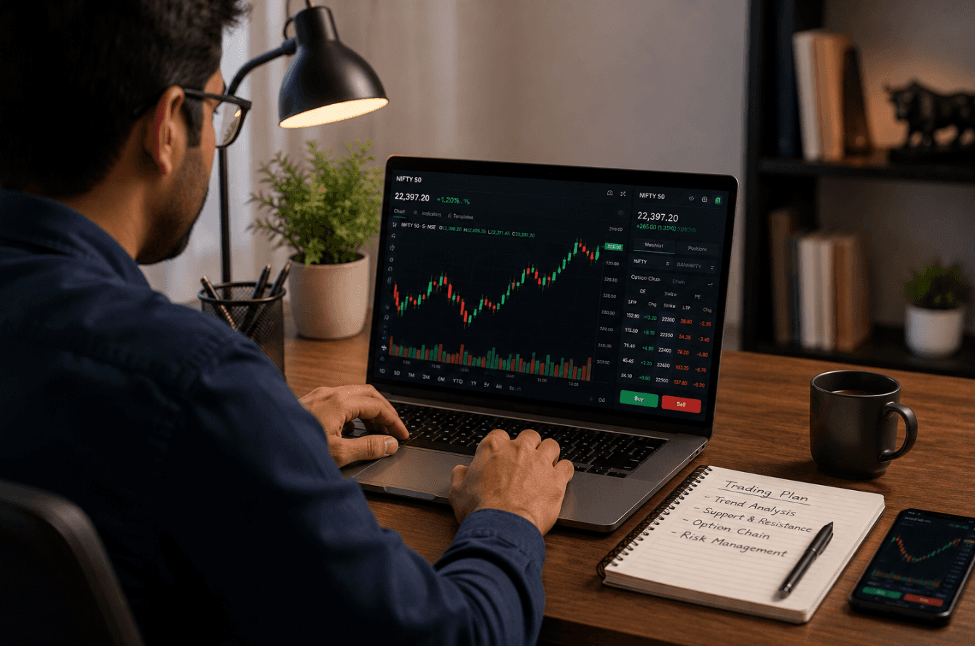
How Does Nifty 50 Option Trading Work?
Nifty 50 Option Trading means trading options based on the movement of the Nifty 50 index. For beginners, the process can seem confusing because it involves understanding the Nifty index, calls and puts, strike prices, option premiums, expiry, and market movements.
Before entering a trade, it is important to understand how these different elements are connected. The price of the Nifty 50 can influence an option's value, while the selected strike, time remaining, and market conditions can also affect how the option behaves.
In this guide, we will explain how Nifty 50 Option Trading works. We will look at how Nifty options are structured, how traders analyze the market, how they select an option, what can affect its value, and what happens after a trade is placed. The goal is to give beginners a clear understanding of the process before they start exploring Nifty 50 options.
What Is Nifty 50?
Before understanding Nifty 50 Option Trading, it is useful to know what the Nifty 50 itself represents. Nifty 50 is a major stock market index in India and is closely followed by traders and investors. Since Nifty options are based on the movement of this index, understanding the underlying market can make the option-trading process easier to follow.
1. Understanding the Nifty 50 Index
The Nifty 50 is an index that tracks 50 leading companies listed on the National Stock Exchange of India. It provides a broad view of how a group of major companies is performing in the Indian equity market.
For an option trader, the Nifty 50 is important because Nifty options are linked to the index. When learning how these options work, it helps to first observe how the index moves during different market conditions.
2. How the Index Represents the Indian Equity Market
The Nifty 50 brings together companies from different sectors of the Indian economy. Because it includes major companies, its movement is widely watched as an indicator of overall market activity.
This does not mean that every company in the index moves in exactly the same way. However, the combined movement of the constituent companies contributes to changes in the index.
For someone learning Nifty 50 Option Trading, understanding this relationship provides useful context before moving into option-specific concepts.
3. Why Traders Follow Nifty 50
Traders closely watch Nifty 50 because its movement can provide information about the broader market environment. During a trading session, traders may study whether the index is moving upward, downward, or within a range.
Nifty 50 is also widely used as an underlying for derivatives. This makes understanding its price movement an important part of learning how Nifty options work.
Rather than looking only at an option's premium, traders can first study what is happening with the Nifty itself and then connect that information with the option they are considering.
4. Understanding Nifty Spot
Nifty spot refers to the current level of the Nifty 50 index. It provides a reference point for understanding where the index is trading at a particular time.
The spot level is also useful when studying different option strikes. Traders can compare the current Nifty level with available strike prices to understand whether an option is ITM, ATM, or OTM.
For beginners, regularly observing the Nifty spot can make it easier to understand the connection between the underlying index and its options.
What Are Nifty 50 Options?
Nifty 50 options are derivative contracts based on the Nifty 50 index. They give traders a structured way to participate in potential movements of the index without directly buying or selling the individual companies that make up the index.
1. Understanding Index Options
An index option is an option contract based on a stock market index rather than an individual company. In the case of Nifty options, the underlying is the Nifty 50.
There are two basic types of Nifty options: Call options and Put options. Understanding these two types is an important starting point for anyone learning how Nifty 50 Option Trading works.
2. How an Option Contract Works
An option contract has specific details, including the option type, strike price, expiry, and premium. These elements determine the terms of the option being traded.
A trader needs to understand these details before entering a position. The strike price and expiry date can affect how an option behaves. This means two Nifty options based on the same index can perform differently.
3. What the Buyer Gets From an Option
When someone buys an option, they pay a premium for the contract. A call gives the buyer exposure to a potential upward move in the underlying, while a put gives exposure to a potential downward move.
The buyer is not simply buying the Nifty 50 itself. Instead, they are buying an option contract whose value can change as market conditions change.
Understanding this distinction is important for beginners because an option has its own price and characteristics.
4. Understanding the Option Premium
The option premium is the price paid to purchase the option. It can change as the Nifty 50 moves and can also be affected by other characteristics of the option.
Different strikes can have different premiums. The amount of time remaining and the relationship between the strike and current Nifty level are also important when studying an option.
For this reason, beginners should understand the premium rather than assuming that a lower-priced option is automatically a better choice.
5. Why Nifty Options Have Different Strike Prices
Nifty options are available at different strike prices around the current Nifty level. This gives traders multiple contracts to study when analyzing a potential position.
The relationship between the strike price and the Nifty spot level determines whether an option is generally considered ITM, ATM, or OTM.
Understanding these differences helps traders compare available options instead of treating every Nifty option as the same.
How Nifty 50 Option Trading Actually Works
The basic process of Nifty 50 Option Trading involves studying the Nifty, selecting an appropriate option contract, and managing that position according to a trading plan. Each step has its own considerations.
1. The Relationship Between Nifty and Its Options
The first thing to understand is the connection between Nifty 50 and its options. If the Nifty moves, the value of its options can also change. However, the option premium may not move by exactly the same amount as the index.
Different strikes and other characteristics of the contract can affect how the premium responds. This is why traders generally study the underlying Nifty along with the specific option they are considering.
2. Selecting an Expiry
Every Nifty option contract has an expiry. The expiry determines how long the contract remains active. When studying an option, traders need to consider which expiry they are looking at because two options with the same strike and type but different expiries can have different premiums and behaviour.
Beginners should understand the expiry associated with a contract before considering a trade.
3. Selecting a Strike Price
After studying the Nifty level, a trader can compare the available strike prices. The selected strike has a direct relationship with the current Nifty spot level.
ITM, ATM, and OTM options can behave differently, so strike selection should be based on an understanding of the contract rather than simply choosing the option with the lowest premium.
4. Choosing a Call or Put
The next step is choosing whether the situation being analyzed relates to a call or a put. A call is generally associated with an expectation of an upward movement, while a put is generally associated with an expectation of a downward movement.
However, the direction alone does not determine the outcome of a trade. The selected strike, premium, expiry, and actual Nifty movement also matter.
5. Paying the Option Premium
When an option is purchased, the buyer pays the option premium. This is the cost associated with purchasing the option contract. The premium can change after the position is opened.
If the option's market price increases, the buyer may have an opportunity to exit at a higher price; if it decreases, the position can lose value. This is why understanding premium behaviour is an important part of Nifty 50 Option Trading.
6. Monitoring the Position
After entering a trade, the process does not end. Traders need to monitor the position and compare what is actually happening with the original trade plan.
The Nifty may move differently from what was expected, or the option premium may behave differently. Monitoring the position allows the trader to make decisions based on the current situation rather than ignoring changes in the market.
7. Exiting Before or Holding Until Expiry
An option position can be closed before expiry by exiting the trade, depending on the trading approach. Traders may also hold an option until expiry, in which case the outcome depends on the contract's value and applicable expiry conditions.
For beginners, understanding that an option trade has both an entry and an exit is important. The objective is not simply to identify an option to buy but to understand the complete process from selecting the contract to managing and closing the position.
Call vs Put in Nifty 50 Trading
Understanding the difference between a call and a put is one of the basic steps in learning Nifty 50 Option Trading. Both are option contracts, but they are generally used when traders have different views about the possible direction of the Nifty 50.
A call is generally associated with an upward market view, while a put is generally associated with a downward market view. However, choosing between them requires more than simply deciding whether Nifty may rise or fall.
1. How a Nifty Call Works
A Nifty call option gives the buyer exposure to a potential upward movement in the Nifty 50. When studying a call, the trader looks at the current Nifty level, the selected strike price, the option premium, and the expiry.
If Nifty moves in a favourable direction, the call premium may increase. However, the actual premium movement depends on the characteristics of the option and the market conditions.
For beginners, the important point is to understand that buying a call is not the same as directly buying the Nifty 50. It is an option contract whose value changes according to the underlying market and other factors.
2. How a Nifty Put Works
A Nifty put option is generally studied when a trader expects a possible downward movement in the Nifty 50.
Similar to a call, the buyer pays a premium to purchase the put. If Nifty moves in a direction that benefits the position, the put premium may increase. If the market moves differently, the option can lose value.
Understanding how puts work gives beginners the other side of Nifty option trading and helps them understand why traders may study both calls and puts when analyzing the market.
3. What an Upward Nifty Move Means for Calls
When Nifty moves upward, a call option may benefit from that movement. However, the size and timing of the Nifty movement matter.
For example, a small upward movement may not produce the same premium response as a stronger movement. The selected strike and time remaining on the contract can also affect the option's behaviour.
Therefore, an upward Nifty move should be viewed as one part of the analysis rather than an automatic indication that a call trade will be profitable.
4. What a Downward Nifty Move Means for Puts
A downward movement in Nifty can support a put option, but the outcome still depends on the specific contract and market conditions.
The selected strike, premium, and remaining time can influence how the put responds to a change in Nifty. This is why traders need to look beyond the direction of the index.
For anyone learning Nifty 50 Option Trading, understanding this relationship can help create more realistic expectations about how calls and puts behave.
5. Why Direction Alone Does Not Determine Profitability
Knowing that Nifty may move up or down is not enough to determine whether an option trade will be profitable. The trader also needs to consider the option's strike price, premium, expiry, and how much the underlying actually moves.
For example, a trader may correctly anticipate an upward movement but still see a different-than-expected result in the option because the movement was small or occurred differently from the planned timeframe.
This is why option trading involves more than predicting direction. Understanding the contract and the factors affecting its value is equally important.
Understanding the Nifty Option Premium
The option premium is the price paid by an option buyer for the contract. Understanding how this premium behaves is essential because the trader enters the position by paying a premium and later observes changes in that value.
1. What the Premium Represents
The premium represents the market price of the option contract. It reflects the value that market participants assign to that particular option at a given time.
Different Nifty options can have different premiums depending on factors such as their strike price, expiry, and relationship with the current Nifty level.
For beginners, it is useful to think of the premium as the price of the specific option rather than assuming that every Nifty option will respond in the same way.
2. Why Premiums Change During the Day
Option premiums can change throughout a trading session as market conditions change.
Changes in Nifty itself can influence the premium, while the amount of time remaining and the option's position relative to the current index level can also affect its value.
This means an option that has one premium at the beginning of a session may have a very different premium later in the day.
3. How Nifty Movement Affects Premiums
Because Nifty options are linked to the Nifty 50, changes in the index can affect option premiums.
A call may generally respond positively to an upward movement, while a put may generally respond positively to a downward movement. However, the response is not always identical across different contracts.
The strike price and other characteristics of the option matter. This is why traders study both the underlying Nifty movement and the specific option premium.
4. Why Two Different Strikes Can Have Different Premiums
Two Nifty options can have different strike prices and therefore different premiums, even when they belong to the same expiry.
The relationship between each strike and the current Nifty level influences how the options are positioned. ITM, ATM, and OTM options can therefore have different prices and respond differently to market movements.
Comparing strikes helps traders understand why one option may cost more than another instead of assuming that the cheaper option is automatically better.
5. Understanding Premium Movement Near Expiry
As expiry approaches, the amount of time remaining in an option becomes shorter. This can affect the premium, particularly the time-value component.
Beginners should understand that an option does not simply retain its value until expiry. Its premium can change significantly as the expiry date gets closer.
For this reason, time should be considered alongside Nifty movement when studying an option.
Strike Prices: How Traders Choose Among Options
Strike price is another important part of Nifty 50 Option Trading. Nifty options are available at multiple strikes, so traders need to understand how these strikes relate to the current Nifty level.
1. What Is a Strike Price?
The strike price is the predetermined price level associated with an option contract.
When selecting a Nifty option, the trader chooses a particular strike along with the option type and expiry. Different strikes can have different premiums and can respond differently to movements in Nifty.
Understanding the strike is therefore essential before entering an option position.
2. How Strikes Are Positioned Around Nifty
Nifty option strikes are positioned at different levels around the current Nifty spot price.
For example, some strikes may be below the current Nifty level, while others may be above it. As Nifty moves, the relationship between the spot price and these strikes can change.
Studying this relationship helps traders understand why the same market movement can affect different options differently.
3. ITM, ATM and OTM Options
Nifty options are commonly described as In-the-Money (ITM), At-the-Money (ATM), and Out-of-the-Money (OTM) based on the relationship between the strike price and the current Nifty level.
ATM options have a strike close to the current Nifty level. ITM and OTM options are positioned differently relative to the underlying index.
These categories help traders describe and compare different options. Beginners should understand what each category means before comparing available contracts.
4. Why Different Strikes Behave Differently
Different strikes have different relationships with the Nifty spot price. As a result, their premiums may respond differently when Nifty moves.
An option closer to the current Nifty level may behave differently from one that is further away. The remaining time and market conditions can also influence the response.
Therefore, choosing a strike is not simply about finding the option with the lowest premium. The trader needs to understand what the selected strike represents.
5. What Beginners Should Compare Before Selecting a Strike
Before selecting a Nifty strike, beginners can compare the current Nifty spot level with available strikes and examine the corresponding premiums.
It is also useful to consider the option type and expiry and understand whether the option is ITM, ATM, or OTM.
The purpose is to understand the contract before entering it. A systematic comparison can help beginners avoid choosing a strike simply because its premium looks attractive.
Expiry and the Life of a Nifty Option
Expiry is an important part of an option contract because it determines when the contract reaches the end of its defined period. Anyone learning Nifty 50 Option Trading should understand how time remaining can affect an option.
1. What Is Option Expiry?
Option expiry is the date associated with the end of an option contract's validity. Every Nifty option is linked to a specific expiry.
When comparing two options, it is therefore important to know whether they belong to the same expiry or different expiry periods.
2. How Time Affects an Option
An option has a limited amount of time before expiry. As that time decreases, the option's characteristics can change.
This is particularly important for option buyers because the time available for the expected market movement becomes shorter.
Understanding this factor helps explain why an option cannot be evaluated only by looking at the current Nifty price.
3. What Happens as Expiry Gets Closer?
As expiry approaches, the remaining time becomes smaller. This can affect the option premium, including its time-value component.
The behaviour can be different for options with different strikes and market conditions, so traders need to consider the specific contract they are studying.
For beginners, the key lesson is simple: time is part of an option trade.
4. Understanding the Difference Between Intraday and Holding an Option
An option position can be opened and closed during the same trading session, or a trader may hold the position for a longer period according to the contract and trading approach.
These approaches involve different considerations. An intraday trader may focus closely on movements during the session, while someone holding an option needs to consider the additional time remaining and changes in the option's value.
Understanding this difference helps beginners see why the same option can behave differently depending on when it is entered and exited.
5. What Happens to an Option at Expiry?
At expiry, the option reaches the end of its contract period. The outcome depends on the option's relationship with the underlying Nifty and the applicable settlement process.
For an option buyer, understanding what happens at expiry is important before holding a position toward the end of its life.
Beginners should therefore know the expiry of the option they are studying and understand how the value of the contract can change as that date approaches.
How Traders Analyze Nifty Before Taking an Option Trade
Before taking a Nifty option trade, traders first look at what is happening in the Nifty 50. They study its price movement, chart, and important levels before looking at a particular option. This helps them understand the market situation and make a more planned decision.
1. Studying Nifty Price Movement
The first step is to watch how Nifty is moving. It may be moving upward, downward, or within a range.
Look at how quickly the price is moving and whether the movement is steady or changing often. Watching these movements can help you understand the current market situation before choosing an option.
2. Understanding Price Action
Price action means looking at how the price itself is moving. You can observe where Nifty moves, stops, changes direction, or reacts to certain levels.
Instead of only guessing where Nifty may go, study what the price is actually showing. This can give you useful information before making a trading decision.
3. Reading Basic Candle Behaviour
Candles show how Nifty moved during a particular period. They show the opening price, closing price, highest price, and lowest price.
Beginners can start by understanding basic bullish, bearish, and neutral candles. Looking at candle bodies and wicks can also help you understand how price behaved during that period.
4. Looking at Important Price Levels
Traders also watch important Nifty levels, such as previous highs and lows. These levels can help them understand where price has reacted before.
Watch what happens when Nifty reaches these levels. It may move through the level, stop around it, or move in another direction.
These levels are only part of the analysis and should not be treated as automatic trading signals.
5. Studying Nifty Spot Before Looking at the Option
It is useful to study the Nifty spot price before choosing an option. First understand where Nifty is trading and how it is behaving. Then you can look at different options and compare their strikes and premiums. A simple process is:
Study Nifty → understand its movement → identify a possible setup → study the option.
6. Why the Underlying Market Matters
Nifty options are based on the Nifty 50, so changes in Nifty can affect option prices. However, an option premium does not always move by the same amount as Nifty.
The strike price, expiry, and other factors can also affect the option. This is why understanding Nifty first is an important part of Nifty 50 Option Trading.
Understanding the Nifty Option Chain
The option chain shows information about different Nifty call and put options. It can help traders compare different strike prices and understand activity in the options market.
1. What Information Does an Option Chain Provide?
An option chain shows different strike prices along with information about call and put options.
It can include details such as option prices, Open Interest, and volume. Beginners may find the option chain confusing at first, so it is better to learn each part step by step.
2. Call and Put Sides
The option chain has separate call and put sides. This allows traders to compare activity at different strikes.
Looking at both sides can give you a wider view of the options market instead of focusing only on one option.
3. Understanding Open Interest
Open Interest shows the number of option contracts that are still open. Traders can compare Open Interest across different strikes and look at activity on the call and put sides.
However, Open Interest should not be treated as a guaranteed prediction of where Nifty will move. It is only one part of the information used in analysis.
4. Studying Volume
Volume shows how much trading activity an option has during a particular period.
Looking at volume across different strikes can help you understand which contracts are being actively traded. However, volume should be considered along with Nifty price movement and other information.
5. Comparing Different Strikes
Different Nifty strikes can have different premiums, Open Interest, and volume.
Comparing these details helps traders understand the differences between available options and decide which ones need further study.
6. Using Option Chain Data Alongside Price Movement
The option chain should not be studied separately from Nifty's movement. A simple approach is:
Study Nifty → understand price movement → check the option chain → compare strikes → plan the trade.
This helps prevent one piece of option-chain data from becoming the only reason for taking a trade.
What Makes a Nifty Option Gain or Lose Value?
An option's value can change after a trader enters a position. Nifty's movement is one important factor, but it is not the only one.
1. Direction of the Nifty
Nifty's direction can affect an option. A call generally benefits when Nifty moves upward, while a put generally benefits when Nifty moves downward. However, the final result also depends on the selected option and how much and how quickly Nifty moves.
2. Distance From the Strike Price
The current Nifty price and the option's strike price are connected. This relationship affects whether an option is ITM, ATM, or OTM. Different types of options can react differently to the same Nifty movement.
3. Time Remaining
Every option has a limited time before expiry. As expiry gets closer, the remaining time becomes shorter. For option buyers, this matters because there is less time for the expected Nifty movement to happen.
4. Changes in Option Premium
The option premium can move up and down during the trading session. Nifty movement, the strike price, expiry, and market conditions can all affect the premium. This is why traders should watch both Nifty and the specific option they are studying.
5. Why Being Correct About Direction May Not Be Enough
A trader may correctly expect Nifty to move up or down but still not get the result they expected from an option. The movement may be too small, happen too late, or affect the selected option differently than expected.
So, Nifty 50 Option Trading is not only about predicting direction. Understanding the option itself is also important.
What Happens During an Actual Trading Session?
Understanding what happens during a trading session helps beginners connect what they learn with real market activity.
1. Before the Market Opens
Before the market opens, traders can review previous Nifty movements and prepare for the upcoming session. The aim is to understand what they need to watch rather than immediately decide to take a trade.
2. Observing the Initial Nifty Movement
When the market opens, Nifty may move quickly or slowly. Instead of reacting immediately, traders can watch the first movements and understand how the market is behaving.
3. Monitoring the Option During Market Hours
If a trader has an open position, they can monitor both Nifty and the selected option. Changes in Nifty can affect the option premium, while the strike and remaining time can also affect the option.
4. Changes in Premium During the Session
An option premium can change many times during the trading session. It may increase, decrease, or move within a range. Watching these changes helps traders understand how options respond to market movements.
5. Deciding Whether to Hold or Exit
A trader should have an exit plan before entering a position.
If the market changes or the original setup is no longer valid, the trader may need to review the position according to the plan.
6. Reviewing the Position After the Session
After the trade, review what happened. Look at the Nifty movement, the option selected, the entry, the exit, and the premium movement. This can help you understand what went well and what you can improve.
Understanding Profit and Loss in Nifty Options
The profit or loss of an option position depends on how the option's price changes after the trade is entered.
1. How Option Buyers Make or Lose Money
An option buyer pays a premium to purchase the option. If the option is later sold at a higher price, the buyer may make a profit before applicable costs. If it is sold at a lower price, the buyer may face a loss.
2. The Role of the Premium Paid
The premium paid is the amount paid when buying the option. As the premium changes, the value of the position also changes. Understanding this helps beginners understand how their profit or loss can change during the trade.
3. Understanding the Difference Between Price Movement and Profit
A change in Nifty does not always mean the same change in your profit or loss. The strike price, option type, expiry, premium, and size of the Nifty movement can all affect the result.
4. Why Timing Can Matter
When you enter and exit a trade can affect its outcome. A trader may correctly understand the market direction but enter too early or exit too soon. This is why timing should be part of the overall trading plan.
5. How Expiry Changes the Outcome
Options have an expiry date. As the expiry gets closer, the remaining time becomes shorter and can affect the option's value. Therefore, traders should always know the expiry of the option they are trading.
Risks Involved in Nifty 50 Option Trading
Understanding risks is an important part of learning options. Nifty option prices can change quickly, so beginners should understand the possible risks before trading.
1. Rapid Premium Changes
Option premiums can move quickly when Nifty moves sharply. This can lead to quick changes in the value of an option position, which means both gains and losses can happen quickly.
2. Time Decay
Options have a limited life. As expiry gets closer, the remaining time decreases. This can affect the value of an option, especially for option buyers.
3. Unexpected Nifty Movements
Nifty may not move as expected. A market setup can change quickly, and an expected movement may not happen. No analysis can guarantee what the market will do.
4. Overtrading
Taking too many trades can make it difficult to follow a clear plan. Beginners may feel the need to trade whenever the market is moving. However, not every market movement is a trading opportunity.
5. Taking Larger Positions Than Planned
Taking a position that is too large can increase the effect of a market move on your trading capital. Understanding how much risk you are comfortable taking is important before entering a position.
6. Trading Without an Exit Plan
Entering a trade without knowing when or why you will exit can lead to emotional decisions. Having an exit plan before entering can help you manage the position more carefully.
Nifty 50 Option Trading vs Nifty 50 Option Buying
These terms are closely connected, but they do not have exactly the same meaning. Nifty 50 Option Trading is a broader term, while Nifty 50 Option Buying refers specifically to buying an option contract.
1. What Option Trading Means
Nifty 50 Option Trading refers broadly to trading option contracts based on the Nifty 50.
It can include different ways of using Nifty options, depending on the trading approach. Therefore, option trading is a wider concept than simply buying an option.
2. What Option Buying Means
Option buying means purchasing a Nifty call or put by paying the option premium.
The buyer takes a position in the option and the value of that position can change as market conditions change.
3. Where Option Buying Fits Into Nifty Option Trading
Option buying is one part of the wider Nifty option-trading category. For example, when someone studies Nifty 50 Option Buying, they may focus on selecting a call or put, understanding the premium, choosing a strike, and managing the position.
How TSTA Can Help You Learn Nifty 50 Option Trading
Our options trading course at Trade Sutra Trading Academy (TSTA) follows a practical, step-by-step approach to understanding Nifty options. Our option buying course covers market analysis, option selection, trade execution, and disciplined decision-making.
1. Nifty 50 and Candle Structure Analysis
The course covers Nifty 50 basics along with bullish, bearish, and neutral candle structures. It also focuses on candle bodies and wicks to help learners understand market behaviour.
2. Strike Price Selection and Nifty Spot Data
Students learn about strike price selection and how to use Nifty spot data when making trading decisions.
3. Option Chain Analysis
The course covers the option chain, including Open Interest and Call-Put dynamics, helping learners understand important option-related information.
4. Gap Trading Rules
Learners study gap-up and gap-down situations and how gap trading rules can be used to plan entry, target, and stop-loss levels.
5. Tick Size and Trade Execution
The course explains tick size and includes a systematic approach to entry, target, and stop-loss planning for trade execution.
6. Price Action and the Three Pillars
TSTA also covers OHLC and price action, along with the three pillars of Risk, Mind, and Money Management to support disciplined trading.
7. Call, Put and Premium Concepts
The course provides an understanding of calls and puts, premium calculation mechanics, intrinsic value, time value, and the relationship between option premiums and Nifty spot prices.
8. Practical Step-by-Step Learning
The overall approach is designed to help learners move from understanding Nifty and option concepts to analyzing setups and developing a more structured approach to Nifty 50 Option Trading.
Conclusion
Nifty 50 Option Trading becomes easier to understand when you learn the process step by step. Start by understanding Nifty 50, then learn calls, puts, premiums, strike prices, expiry, and the option chain.
Before trading, take time to understand how the market works and what risks are involved. A clear learning process can help you make more informed decisions and avoid rushing into trades without proper knowledge.
Trade Sutra Trading Academy (TSTA) can help you build your understanding through structured learning, practical market concepts, and step-by-step guidance in Nifty 50 options.
Frequently Asked Questions
How does Nifty 50 Option Trading really work?
Nifty 50 Option Trading involves studying Nifty, choosing a call or put, selecting a strike and expiry, and then managing the trade.
How do Nifty calls and puts work?
A call is generally used when studying an upward move, while a put is generally used when studying a downward move.
What is the Nifty option premium?
The premium is the price paid to buy an option. It can change as Nifty and market conditions change.
What are ITM, ATM and OTM options?
ITM means In-the-Money, ATM means At-the-Money, and OTM means Out-of-the-Money.
What is Nifty option expiry?
Expiry is the date when an option contract ends. The time left before expiry can affect the option's value.
What are the risks of Nifty 50 Option Trading?
Option prices can change quickly. Beginners should also understand time decay, market movements, position size, and the importance of an exit plan.
Is Nifty 50 Option Trading different from Nifty 50 Option Buying?
Yes. Nifty 50 Option Trading is a broader term, while Nifty 50 Option Buying specifically means buying a Nifty call or put.