

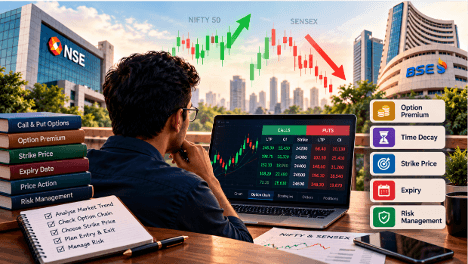
Nifty & Sensex Option Buying in India: What to Know Before You Trade
There are several ways in which the Indian stock market can be traded. Index options are one such method through which traders trade the movements in the Nifty and Sensex. Nevertheless, buying an option requires not only forecasting the movement of the market but also understanding the dynamics of option premium, strike price, expiry, and other aspects influencing the price of an option.
One of the challenges in Nifty & Sensex Option Buying in India is that predicting the market correctly does not always lead to a profitable trade. For example, a trader buys a Nifty Call option when they expect the Nifty index to rise. Even though Nifty indeed grows, the option premium might fail to increase accordingly due to time decay, implied volatility changes, or the price at which the position was opened.
Traders must learn about the Call and Put options, the effect of strike prices on premiums, and the significance of expiry dates before investing in options. It may also be helpful for traders to learn about price action and option-chain analysis to understand the conditions of the market. In addition to these concepts, a proper strategy for entry, exits, and risk management is required since option buyers stand to lose all the money invested as a premium in case of losses.
In this article, we will look into the basic concepts related to the buying of Nifty and Sensex options and the way in which price-action and option-chain analysis should be done. We will also look at some of the common mistakes made by traders that they need to avoid.
Understanding Nifty and Sensex Option Buying
Nifty & Sensex Options help traders trade depending on the direction of India's major stock market indexes. But Nifty & Sensex Option Buying in India is not just about predicting the direction of the stock market, whether up or down. It is also about understanding the relationship between market direction and the premiums of options, strike price and its effects on an option, and timing. These are some of the basics that will help one start learning price action and option-chain strategies.
What Is Nifty Option Buying?
Nifty options trading means that you need to buy either a call or a put option on the Nifty 50 Index, which consists of 50 companies listed on the National Stock Exchange (NSE).
If a trader expects Nifty to rise, they may consider a call option, while an expected fall in the index may lead them to consider a put option. To buy an option, a trader pays a fee called the premium. Its value depends on Nifty's price movement, the time remaining until expiry, and implied volatility.
For example, let us suppose that Nifty stands at 24,000, and an investor buys a call option with the strike price of 24,100. The result will depend on Nifty's movement but also on the premium paid, among other things. The correct prediction does not guarantee profits.
What Is Sensex Option Buying?
The basic concept of Sensex option buying is similar, but the contracts are based on the BSE Sensex, which comprises 30 leading firms listed on the Bombay Stock Exchange (BSE).
Traders can analyze the call options if they feel that the Sensex will go up or put options if they think that the Sensex will fall. But the price of the option is not just dependent on the movement of the index. Factors like strike price selection, time until expiration, and implied volatility can affect it as well.
Since the Nifty 50 and Sensex track different groups of companies, their index values and market movements may vary. Hence, traders need to analyze the index for the option contract that they have chosen.
How Index Options Differ From Buying Shares
When someone purchases company shares, they own the shares. When a trader buys an index option, they purchase a contract linked to the index's price movements rather than owning shares in the companies that make up the index.
Expiry dates are another important difference between the two. Shares can be held without an expiry date, but options expire on a set date. If an option expires worthless, the buyer may lose the entire premium paid. There are also changes that can occur to the premium even before the expiry date due to fluctuations in the underlying index.
With index options, you can take either a bullish or bearish position without having to buy all the individual shares that comprise the index. However, these options require you to be familiar with the contract, its premium, and the risks involved.
Key Differences Between Nifty and Sensex Options
The main difference is the underlying index: Nifty options track the Nifty 50, while Sensex options are based on the BSE Sensex. The terms of the contracts may vary and may change over time. Thus, traders should look up the latest data on the contract terms provided by the relevant exchange before trading.
Liquidity and spread of the options should also be taken into account, as they could influence the price at which the option could be sold. Neither index can be said to be better than the other, as it all depends on the trading style and goals of the trader.
What Beginners Should Understand Before Trading
Before buying Nifty & Sensex options, traders should know about calls, puts, strike prices, premiums, and expiry dates. Also, it is necessary to read price action and option chain data and be able to plan trade entries and exits.
It is equally necessary to practice risk management. Traders need to be aware of the total premium being paid, the quantity of the contract being traded, and that the full premium could be lost. This can be done by practicing with sample trades or paper trading.
After gaining knowledge of the above-mentioned basics, learners can proceed to learn other things like choosing strike prices, price action, and option chains. These concepts are also covered in the TSTA Nifty Ninja Option Buying Course, which focuses on Nifty option buying, candlestick structure, strike price selection, and option chain analysis.
Call Options, Put Options and Strike Price Selection
The concept of call and put options plays an important role in understanding the process of Nifty and Sensex option trading. Both types of contracts help traders position themselves according to their view of the movement of the market. But picking up the appropriate option is not only about knowing whether the index will go up or down. There is much more to learn, including the strike price, premium, and how they relate to the index level.
What Is a Call Option?
A Nifty & Sensex Call option is considered when a trader expects the underlying index to rise. When buying a Nifty & Sensex Call, the trader needs to pay the option premium. The value of the option depends on the movement of the index with respect to time and volatility prevailing in the market.
For example, if the Nifty is at 25,000, a trader buys a Nifty Call option with a strike price of 25,100. A rise in Nifty may increase the option’s value, but the final profit will depend on other factors.
What Is a Put Option?
A trader generally considers a put option when they expect the underlying index to move down. Like a call option, a put option also has a cost called the premium, which can change before expiry.
For example, if Nifty is trading at 25,000, the trader will consider a put option at a strike price of 24,900 in the analysis of a downward movement in Nifty. The put option could be valuable depending on the premium paid, time, volatility, and expiry of the contract.
Both Call and Put options should be treated as separate financial instruments, as neither is guaranteed to be profitable just because the market moves up or down.
What Is a Strike Price?
The strike price refers to the specific price that determines the basis of the option contract. Every call and put has its strike price; various strike prices have various premiums.
For example, if Nifty is trading around 25,000, available option strike prices may include 24,900, 25,000, and 25,100. These options may have different premiums and react differently to market movements.
The trader can compare the level of the index against the strike price and determine whether the option is ITM, ATM, or OTM. These terms help traders compare contracts rather than looking only at the option's price.
Understanding ITM, ATM and OTM Options
In-the-Money (ITM): A call is ITM when the underlying index is above its strike price. A put is ITM when the underlying index is below its strike price.
At-the-Money (ATM): An option is approximately ATM when its strike price is close to the current underlying index level.
Out-of-the-Money (OTM): A call is OTM when the underlying index is below its strike price. A put is OTM when the underlying index is above its strike price.
These terms describe the relationship between the index level and the strike price. They do not determine whether a trade will be profitable. The premium, expiry, volatility, liquidity, and market movement also matter.
What Should Traders Consider When Selecting a Strike Price?
When choosing Nifty and Sensex options, traders should look beyond just whether the premium is cheap or costly. Strike price, index level, expiry period, bid-ask spread, and the time to expiry can influence the behavior of the contract.
For example, an OTM option usually costs less, but the index needs to move in the right direction for it to gain intrinsic value. On the other hand, the ITM option is more expensive since it has intrinsic value. Neither of these contracts is better than the other, as the choice depends on the trade and its risks.
The trader needs to analyze the contract along with their market analysis and determine the risk limits before trading. For further information on this topic, please check our guide about the importance of strike price in options trading.
Understanding Calls, Puts and strike prices provides a foundation for the next step: learning how option premiums, expiry and time decay influence a contract's value.
Option Premiums, Expiry and Time Decay
When someone buys a Nifty & Sensex option, you must do much more than simply guess whether the price of the index is going to move up or down. There is also a link between market movements, time to expiry, implied volatility, and how these affect the option premium.
This is an important part of options trading, as it has a direct effect on the gains/losses of the trade.
What Moves an Option Premium?
An option premium is the price a buyer pays to purchase an option contract. Its value is influenced by several factors:
Index movement: Changes in Nifty & Sensex can affect the premium depending on whether the option is a call or a put and how far its strike price is from the index level.
Strike price: The relationship between the current index level and the selected strike influences the option’s value.
Time to expiry: The amount of time remaining can affect how much time value an option carries.
Implied volatility (IV): Changes in expected market volatility can increase or decrease the premium.
Liquidity: Trading activity and the bid-ask spread can affect the price at which an option can be bought or sold.
These factors interact with one another. Therefore, a trader should not evaluate an option only by looking at its current premium or predicting the index’s direction.
Intrinsic Value vs. Time Value
The option premium is made up of intrinsic value and time value. Intrinsic value shows how much an option is in the money. Time value refers to the probability of an upward movement before expiration.
For a call option, intrinsic value is the positive difference between the index value and the strike price. For a put option, it is the positive difference between the strike price and the index value. An out-of-the-money option has no intrinsic value.
For example, when Nifty is trading at 25,150 and the strike price of the Nifty Call option is 25,100, then the ₹80 premium comprises ₹50 intrinsic value and ₹30 time value.
The premium can change according to the movement of Nifty, time, and implied volatility. This helps traders understand what they are paying for when placing a trade.
How Expiry Affects Option Value
All option contracts are subject to an expiry date. With expiry approaching, the period during which the index moves favorably reduces. This may impact the time value of the option, especially when the underlying index does not show much movement.
If a trader buys a Nifty call option expecting the index to rise but Nifty stays at the same level, the option's value may fall as expiry gets closer. This can happen even when the trader's market view remains unchanged.
The impact depends on the strike price, premium, volatility, and time remaining. Traders should also consider an option's expiry date before entering a trade.
The Cost of Waiting: Time Decay
Time decay means the decrease in the time value of an option as it gets closer to expiry, while holding other things constant. This concept is usually linked to theta, which is one of the metrics used to define the sensitivity of the option to changes in time.
Option buyers should be concerned about time decay because the market move must happen during an appropriate period of time. If the market is range-bound, time decay will occur while waiting for a favorable market move.
Time decay is not something that affects all options in the same manner. Time decay will depend on several things, including the time left to expiration and the strike price.
How Implied Volatility Affects Premiums
Implied volatility measures how much price movement traders expect in the future, based on option prices. It does not predict whether the Nifty & Sensex will move up or down.
If implied volatility rises, it can increase option premiums. If implied volatility drops, premiums may drop as well, even though the underlying index has not changed much.
For example, let us assume that a trader purchases a Nifty call before a significant market event. As a result of the announcement, uncertainty drops, and so does implied volatility. The index itself may move up slightly, but the call premium may increase little or not increase at all.
In this case, it is essential to take into account volatility along with price movement and expiration date. A high premium does not always indicate a good trade, and a low premium does not always imply a good deal.
Apply These Concepts Before Buying
When considering a Nifty & Sensex options trade, keep the following questions in mind:
• Is there a well-defined setup in the index for the expected direction?
• How does the selected strike compare to the index's current level?
• How many days to expiry are left?
• Does time decay become a risk factor if the index moves sideways?
• Will changes in implied volatility impact the premium?
• What is the exit plan if the index doesn't move as expected?
These factors may not guarantee a winning trade but can help traders understand more than just the price and direction of an option.
With a better understanding of how premium, expiry, and volatility work, the next phase is to analyze the underlying index itself. A closer look at Nifty & Sensex price movements, candle patterns, and key price levels could help traders better assess an option entry.
Read the Index Before You Buy the Option
Before buying Nifty & Sensex options, look at the current trend of the index. Is the index trending upwards, downwards, or in a tight range? Observing the movement of prices, candlestick formations, and important support and resistance points will provide you with better insight into the market than guessing or reacting to changes in the premiums of options.
This is important because even choosing the correct direction does not necessarily result in a successful trade. The movement of the index may be slow, reversing, or not breaking significant levels. The analysis of the chart before going long or short can help make an informed decision.
Start With Nifty and Sensex Spot Data
The Nifty spot data will indicate the current trend of the Nifty 50 index, whereas the Sensex spot data will help you understand the trend of the Sensex. Check whether the index is moving up, moving down, or trading sideways.
If the Nifty approaches the resistance levels, see whether the price rises above the level or is sold off at the level. It can be useful to analyze the options trade in context.
Understand Candle Structure
The candlesticks demonstrate the price action for that specific period of time. A bullish candle closes at a higher price than it opens, while a bearish candle closes at a lower price than it opens.
The candle body represents the difference between opening and closing prices. The wicks show the high and low price levels that were attained during that period. A large body can show strong buying or selling pressure, while long wicks can suggest price rejection.
But a single candlestick cannot confirm a trade. Look at the other candles as well.
Use OHLC to Read Price Movement
OHLC stands for Open, High, Low, and Close. These four values show the opening price, highest price, lowest price, and closing price of an asset during a set period of time.
Observation of the OHLC in different candles helps traders detect momentum and breakouts in prices. For example, a closing price higher than the resistance level can show strength, but traders must see whether the price holds above or goes back below that level.
Price action mastery for Nifty options buying will help you to know how the candlestick pattern works together with the movement of the index.
Identify Trends and Important Levels
An uptrend will form higher highs and higher lows, while a downtrend will form lower highs and lower lows. If the index moves around the same level several times, it may be trading sideways.
The support and resistance levels assist traders to identify where the price action may either pause, reverse, or break through. However, support and resistance areas cannot guarantee the exact turning point of the price.
Connect Index Movement With Option Buying
Once you have identified the index movement, you will be able to determine if a call or put works well in the given situation. A possible up-move will make you consider calls, while a possible down-move will make you consider puts.
Other factors that you should consider before taking the trade include the strike price, premium, expiry date, and liquidity of the option. Although the index moves in your predicted direction, the option may not appreciate as you expect because of time decay and implied volatility.
Your objective is to analyze the index first, confirm the movement, and then make plans on how to take the trade.
How to Read the Option Chain
The option chain assists in understanding the trading activity in Nifty and Sensex option trades. The option chain shows the call and put options at different strike prices and expiry dates. The information provided includes the premium, open interest, and volume. These help traders compare available contracts and see where market activity is higher.
For option buyers, reading the option chain makes strike selection systematic and helps evaluate the available trading opportunities. Along with the index price movement, it provides more insight when analyzing a call or put.
What Information Does an Option Chain Provide?
Information like strike price, option premium, open interest, open interest change, and trading volume may be viewed through the option chain. These figures will give you the ability to make choices about which option contract would work best for you.
Analyzing this data before buying an option can help you make a better decision.
Understand Call and Put Data
Call and put data help traders compare options at different strike prices. This allows them to find out how the available contracts are different from each other.
For example, if a trader is going to buy a call option, he can compare premiums and trading volumes for the strike prices that are close and then select a contract. The same method applies when buying put options and expecting a fall in the market.
Open Interest and Volume
Open Interest (OI) measures the number of option contracts that have not been settled. Analyzing the trends of OI can assist traders in noting how the position develops in relation to the various strike prices.
Volume is the number of contracts traded over a certain period of time. High volume can indicate heavy trading activity and help traders identify contracts that are actively traded.
Looking at OI and volume together gives traders a better understanding of market participation.
Compare Strike-Wise Information
By comparing the various strike prices, traders can get an understanding of how the premium, open interest, and volume change on the option chain. Some traders also look at where OI is concentrated.
This comparison can support strike selection by helping traders evaluate available contracts alongside their market view, budget, and expiry preferences.
Combine Option-Chain Data With Spot Price Action
The option chain becomes more useful when used along with the actual movements of Nifty & Sensex. If Nifty is nearing a resistance level, traders should watch its price action along with OI and volume for nearby strike prices.
Traders should consider all these points before deciding whether to buy a call or put option. The important thing here is that option-chain data should be just part of the analysis done to check whether the movement of the index confirms the trading decision.
Reading the option chain helps traders organize information, compare opportunities, and make informed decisions.
Gap-Up and Gap-Down Trading: What to Check at the Open
Gap up and gap down are terms used to describe the opening of the Nifty and Sensex at a price much higher or lower than their previous close. This is the kind of information that is useful for option buyers because they need to be informed not only about the opening but also about what happens next with the index. Price action analysis is required before traders enter a trade position.
Understand Gap-Up and Gap-Down Openings
A gap up occurs when the index opens higher than it closed in the previous session, while a gap down happens when the index opens lower than its previous closing price. These movements may happen because of unexpected overnight events in global markets or changes in market sentiment.
A gap up may indicate bullish market sentiment, while a gap down may signal selling pressure. However, the market's initial movement does not determine how it will move throughout the day.
Observe Price Action After the Open
The initial candles will help traders to see how the market reacts to the opening gap. For example, if Nifty opens higher than its previous close and holds above its opening range, it may indicate strong buying pressure. If the index falls back below its opening range, the early buying strength may begin to fade.
In case the index gapped down at the beginning, the trader should observe whether there is more selling pressure or if the market recovers. Knowing how gap-up and gap-down trades take place can assist traders in understanding these price movements.
Check Important Price Levels
Before choosing between a call or put, check the index chart for the nearest support and resistance levels, the previous day's high and low, and the opening range. These levels serve as reference points to determine where the price will face buying/selling pressure.
For example, if Nifty opens above resistance, see if the index can hold that level. This may indicate that further analysis of a bullish setup is possible.
Plan the Trade Before Entering
When there is potential for setup formation, determine the entry criteria, as well as profit target and stop-loss levels. Consider the premium value of the selected option along with its strike price, expiry date, and liquidity before trading.
Traders need to have a strategy in place to make sure that they do not take hasty decisions when prices change after the opening of the market.
Avoid Chasing the First Move
An immediate gap-up or gap-down can give rise to feelings that you must trade right away. By the time traders execute their trade, the option premiums can have gone up or down.
Taking time before entering into a trade will allow traders to evaluate the direction of the market and the quality of the setup. The idea is not to trade all opening gaps.
Right Direction, Wrong Trade: Why Option Buyers Lose
Determining whether Nifty & Sensex will rise or fall is just one aspect of options trading. Even if a trader makes the right prediction about the direction of the index, he may end up losing money due to the timing of the entry, strike price, or premium.
Knowing all these details helps us understand why simply predicting the market's direction does not always lead to a profit from an option trade.
Entering Too Late
If the index has already made a big move, the premium on the option may have risen quite a lot. This can reduce the profit potential of the trade, especially if the index starts to slow down or reverse its movement.
If a trader waits for a suitable setup instead of reacting to a sudden market move, they can assess the possible risk and reward before entering the trade.
Choosing an Unsuitable Strike Price
Different strike prices react in different ways to changes in the underlying index. Even though a deep out-of-the-money option may cost less than other options, the index usually needs to move further in the expected direction for the option to become profitable at expiration.
Strike selection should depend on the market setup, premium, expiry, and expected movement in the index, not just the premium.
Ignoring Time Decay
Options have a limited lifespan. As the expiry date approaches, an option's time value usually decreases, assuming other factors remain unchanged.
This becomes especially important when the market lacks momentum and doesn't produce the expected price move.
Overlooking Implied Volatility
The value of options is also determined by implied volatility. The decrease in implied volatility will lead to a reduction in the value of the option, even if the index changes in the anticipated way.
This is especially important before any major news or event because option prices can rise when traders expect the market to move sharply.
Poor Entry and Exit Planning
Trades made without a proper plan, risking too much money, or failing to exit at the right time can result in higher losses. Before executing a trade, the trader must set out the entry conditions, stop-out level, and target/loss level.
A Simple Example: Correct Prediction, Losing Trade
Let us take an example where Nifty is at 25,000, and a trader buys a call option for ₹100, expecting the index to rise. Nifty then rises to 25,050, but the move is slower than expected, and the option premium falls as time passes. In this situation, if the premium drops from ₹100 to ₹85, the trader would incur a loss of ₹15 per unit.
This example shows why traders need to understand not just the direction of the market but also how strongly it moves and whether the option premium makes the trade worthwhile.
Plan the Trade Before You Enter
The good trade actually starts even before you decide to trade. When trading options on Nifty and Sensex, it is very easy to concentrate on profits and neglect everything else that can happen in case your assumptions turn out to be wrong. Trade planning helps you understand what type of trade you have got there, select a proper trading instrument, and decide how you will exit from the trade.
Define Your Entry Setup
You should first decide what you want to look for in the index. This may either be a breakout of resistance, a retrace to support, or continuation of the current trend. You must make sure that the price action favors your trading plan before executing the trade.
Choose the Option Carefully
After you are done with all of that, proceed to choose the option among available choices by looking at various things such as strike price, premium, expiry date, and liquidity of the option itself. Choose an option that would work for you based on market movements you have analyzed previously and the funds available for investing.
Set Your Target and Stop-Loss
Identify the price level where you expect to make a profit and the price movement that would show your analysis is incorrect. Set up your stop levels before buying rather than doing it out of fear or excitement. Note that fast changes in the market may result in an order being executed at an unexpected price level.
Calculate Your Risk Before Placing the Order
Calculate how much you will be ready to lose and set the size of your position. For example, if your risk is ₹1,000, the volume will depend on the amount of money you are going to lose as a result of your decision to exit the trade.
Review the Trade After Exit
Once the trade is closed, check how well you followed your plan. Think about whether your entry made sense, how you managed the trade, and what you could do better next time. Keeping a trading journal helps you spot repeated mistakes and make better trading decisions in the future.
Risk, Mind and Money Management
Effective option trading requires more than finding the opportunity in the market. A trader must know how much he or she is willing to lose on the trade, how much money is required for the position, and what should be done if the trade goes against their expectations. In Nifty and Sensex options, where premiums can change instantly, these factors can really affect your trading activity.
Management of risk, money, and emotions comes together. To prevent making rushed decisions, you should set some rules before entering a position, as these rules can help you handle trades calmly and make better decisions. Of course, profits are never certain.
Protect Your Trading Capital
Before placing a trade, decide how much risk you are comfortable taking. Do not involve money designated for personal use or for any other financial considerations. Deciding on a daily loss target will help you avoid situations where a tough trading day might make you trade riskier.
For example, when your trade goes against your expectations, you shouldn’t increase your position to break even. Taking a planned loss and analyzing your mistake is usually better than letting yourself be governed by frustration and losing rationality.
Choose the Right Position Size
The position size is the amount of money exposed by way of any trade. Adding more lots can increase both your potential profit and potential loss.
When planning to buy an option in Nifty & Sensex, you need to work out the total cost of buying the option as well as the loss you could face if the option hits the planned exit price.
Your position size should depend on how much risk you are comfortable taking, not how sure you feel about the trade. If the position size involves too much risk, it may be better to skip the trade.
Keep Emotions Under Control
Fear and greed affect traders in different ways. For example, fear makes you close the trade too soon, while greed makes you keep a winning trade open for much longer than planned.
Another common error that traders make is entering the trade in reaction to an abrupt move since you think you have lost out on an opportunity. Instead, you should check whether there is still an opportunity.
Make plans for how you will enter and exit the trade before placing the trade order. If you feel frustrated after losing a trade, take a break from trading.
Avoid Overtrading
Not every move on the Nifty & Sensex will provide you with a good opportunity to make money through trading. Trading in random moves can cost you a lot and expose your account to losses.
Revenge trading can be really harmful to you. After a trade loss, traders may enter another trade only to recover the money they lost in the previous trade. This can lead traders to make one poor trading decision after another.
It is better to have some defined limits on your trading platform and not enter any position on the basis that the market is active enough.
Review Your Trading Decisions
Keep a trading journal to record your entry and exit prices, the reason for taking the trade, position size, and the result of the trade. Check out whether you have followed your initial strategy and find out how to improve on it next time.
This will allow you to identify certain patterns in your behavior, such as entering a trade too late or increasing your volume after a loss. You may also want to look at this guide on risk management in option buying.
The important thing to remember here is that traders should not try to avoid all losses. They need to make the right decisions and avoid repeating mistakes in the future.
Common Mistakes to Avoid in Nifty and Sensex Option Buying
Understanding the operation of index options is just one way that you can become an informed trader. Sometimes traders are prone to making mistakes when they fail to consider crucial information. It is something traders should learn from, as it helps them evaluate trading situations better.
Buying Only Because an Option Looks Cheap
A low-cost option may look like a good deal, particularly for beginners who have little money to start with. However, an option being cheap does not necessarily mean it offers a good opportunity. Out-of-the-money options far from the money might need a large movement in the index before becoming profitable.
Ignoring the Underlying Index
Traders are often so fascinated with option premiums that they overlook the fact that Nifty and Sensex should be analyzed as well. This will give important information about whether the idea to open the trade makes sense or not. For instance, buying calls on the growing premium might prove dangerous if the base index is near a key resistance level.
Trading Without an Exit Plan
Entering into a trade without knowing the exit point of the trade is asking for trouble. You can find yourself holding on to a losing trade for too long or selling off a winning trade at the wrong point in time. To avoid this problem, you must make sure that you have certain rules to determine the appropriate exit point of your trade.
Relying on One Candle or One Option-Chain Figure
You should not rely on a single candlestick, a spike in volume, or any sudden change in open interest. All these factors require analysis of other details that might affect their interpretation. While one candle looks quite bullish, it does not necessarily mean that there are some strong uptrends in the market and vice versa. There might be an increase in open interest, but it is still difficult to say whether the market will move up or down.
Ignoring Expiry and Volatility
Although it is possible to predict the trend correctly, this knowledge by itself would hardly lead to proper decisions regarding the options. As the expiration date comes closer, time value falls, and volatility might play a major role in the premium rate changes. It is important to know about both of these aspects.
Increasing Trade Size After a Loss
After a losing trade, some traders may increase the position size of the next trade to get back the lost money. This decision can lead to losses, especially if the trader does not carefully review the next trade. Your decisions should match the trading method that you have chosen.
Avoiding these mistakes will not always lead to profits, but it can help you evaluate your trades more objectively. Making such decisions begins with understanding the available information.
How to Build Your Option-Buying Knowledge Step by Step
Nifty and Sensex options trading require patience, experience, and the ability to analyze one’s own decisions. Rather than trying to learn all the aspects of trading, it is better to do this gradually. Each step will help you to better understand the market information before making decisions.
Learn the Basic Terms of the Contract First
First, learn how call and put options work, along with strike prices, expiry dates, and option premiums. It is also important to learn the difference between in-the-money, at-the-money, and out-of-the-money options. Knowledge of all these terms is necessary for understanding why some of the contracts perform differently despite being linked to the same index.
Practice Candle and Nifty Spot Chart Reading
Once you get the basics, practice reading Nifty Spot charts. Study candles in different setups, price movements, and changes in market structure. Notice how the index reacts near previous highs and lows. Try not to memorize the patterns. Instead, understand the price movement and check whether the rest of the chart supports your view.
Strikes and Option Chain Information
In the next level, observe the reactions of different strikes depending on the movement of the index. Observe calls and puts, premiums, expiration, volume, open interest, and bid-ask spreads. Try to understand what information can be obtained from such data and what cannot be derived from this data. Here, you aim to learn about the contract and not choose an option by reading its premium.
Review of Hypothetical or Paper Trades
Hypothetical trades will enable you to practice how to analyze the different possible setups without taking any trades in reality. This is an opportunity for you to write down the factors that would make you open such a trade, the particular contract you were going to use, the subsequent price movement of the instrument, and what it would have meant for your setup.
Trade Journal and Decision Evaluation
Write down all your observations as well as the hypothetical trades. Write down the date, the market conditions, the purpose of the trade, and what followed thereafter. These should be reviewed to see if there is anything that you might have misunderstood in your analysis.
It will allow you to study at your own pace and analyze the reason why you chose a certain option. Also, you will be able to comprehend how options work, the movements in the market, and the use of charts in decision-making while trading. If you want to learn more about structured trading education, read our guide on choosing the right options academy.
Conclusion: Understand the Setup, Not Just the Direction
Options trading in Nifty and Sensex involve more than simply guessing whether the market will go up or down. Although the index does move in the predicted direction, the option itself might not work out the way the trader expects. Other determinants include things like the choice of strike price, premiums, expiration time, and the existing market environment.
It is important to know how all these factors work together when assessing an options trade. Analyzing the underlying index allows the trader to understand what is going on and put the price action into perspective. Candlestick patterns, price structure, key levels, and option chain data can all help you read the market. However, no tool can predict market movements with certainty.
Time decay and implied volatility also affect option premiums. These factors might influence the value of an option even when the index behaves in the predicted manner. It is for this reason that traders have to go beyond simply considering the direction of the index and consider what could influence the option contract that they have chosen. Proper understanding of all these elements will assist in making the market analysis more informed, even though the possibility of loss still exists.
For learners who want to continue with their learning process, Trade Sutra Trading Academy is one resource that is associated with trading and the understanding of market concepts. The key to everything is continuous learning and proper interpretation of market data.
Frequently Asked Questions
1. What is Nifty and Sensex Option Buying?
Nifty and Sensex option buying involves purchasing call or put contracts based on an expected movement in the respective index. Buyers pay a premium to purchase these contracts and may profit if the option's value increases. However, market direction, expiry, and volatility all influence the outcome.
2. What is the difference between a call and a put?
The call option is usually bought by a trader when he expects an increase in the price of the index, whereas a put option is usually bought when he expects a fall in its price. Both allow the trader to take a position without investing in the stocks of the index.
3. What is the impact of strike price on an option?
A strike price is the pre-set price that is attached to the option contract. The relationship of this price with the current index level helps determine whether the option is either in the money, at the money, or out of the money. The relationship is also helpful in determining the premium of the contract.
4. Can an option buyer lose the entire premium?
Yes, an option buyer can lose the entire premium if the option expires worthless. This can happen when the option is out of the money at expiry.
5. Why can an option premium fall when the index rises?
An option premium is determined by various factors and not only by an increase or decrease in the index. For example, a call option loses its value when the factor of time decay or implied volatility decline overshadows the effect produced by index growth. The amount of change, strike price, and the time until expiration affect the value.
6. Why do option buyers need to manage risk?
The option premium is highly volatile, and the buyer may end up losing his whole premium. Risk management helps traders evaluate their possible loss, decide on a proper position size, and not risk more money than they can afford to lose.
7. How can beginners get started with Nifty option buying?
Beginners can begin by learning about option contracts, index charts and practicing through virtual trading. Trade Sutra Trading Academy (TSTA) offers a suitable environment for trading education and understanding basic concepts of option buying. Practice does help in getting acquainted, but it cannot eliminate the risk involved in the market.
8. What is the breakeven point when buying an option?
The breakeven point is the price at which the buyer covers the premium paid for the option. For a call option, add the premium to the strike price, while for a put option, subtract the premium from the strike price. These calculations apply when the options are held until expiry and exclude transaction costs.